Study in the UK from Nepal
United
KingdomOne year. A full master’s.
The United Kingdom compresses a master’s degree into twelve months, which makes it the fastest and often the cheapest route to a postgraduate qualification from a globally ranked university. Add the two-year Graduate Route and it becomes a serious career move, not just a degree.
 London, England
Why United Kingdom
What makes it
worth the move.
The case for United Kingdom is specific, not general. These are the four things that actually change outcomes for Nepali students.
Time is money
A one-year master’s means one year of tuition and one year of living costs. For many families that halves the total outlay against a two-year program elsewhere.
Reputation that opens doors
Four of the world’s top ten universities are British, and UK qualifications are recognised without question by employers across Asia and the Middle East.
The Graduate Route
Two years to work in any role for any employer after graduation, with no sponsorship requirement — space to convert a degree into experience.
Reach the rest of Europe
Term breaks put Paris, Amsterdam and Dublin within a short flight, and the UK’s Nepali community is one of the oldest outside Asia.
Universities
Where our students go.
A shortlist should always span reach, match and safety. These are the institutions we most often place students in — the right one for you depends on your grades, budget and target occupation.
University of Oxford
Collegiate teaching and the tutorial system; among the most selective in the world.
Imperial College London
Science, engineering, medicine and business only — and world-leading in all four.
University of Manchester
Large, research-intensive and popular with Nepali postgraduates.
University of Edinburgh
Top-tier for informatics, medicine and the humanities in a compact, walkable city.
University of Birmingham
Strong engineering and business, with generous scholarship access for South Asia.
University of Glasgow
Well-regarded and comparatively affordable, with a large international cohort.
Coventry University
Practical, employability-focused courses with lower fees and January starts.
University of Hertfordshire
Near London at a fraction of the cost; popular for business and computing.
Popular Courses
Fields that lead somewhere.
We advise on course choice from the destination country's demand side, not from what is easiest to get into.
MSc Business & Management
The most common choice; one year, no work experience required for most programs.
MSc Computing & Data Science
Conversion routes available for graduates from other disciplines.
MSc Public Health
A strong option for medical, nursing and allied health graduates.
MSc Engineering Management
Bridges a technical bachelor into leadership and project roles.
MSc International Hospitality
Placement options with major hotel groups in London and Scotland.
MSc Nursing / Health Studies
For registered nurses seeking UK registration and progression.
Cost of Study
What it really costs.
Indicative figures for planning. In your counseling session we build a full budget in Nepali rupees against your specific institution, city and family situation.
| Item | Indicative range (GBP) | Notes |
|---|---|---|
| Postgraduate tuition | 12,000 – 28,000 | Per full one-year program |
| Undergraduate tuition | 11,000 – 22,000 | Per year, three-year degree |
| Living — London | 1,483 / month | The maintenance figure required for visa purposes |
| Living — outside London | 1,136 / month | Nine months must be evidenced |
| IHS + visa fee | 776 / yr + 524 | The Immigration Health Surcharge gives NHS access |
Figures move with policy and exchange rates. We confirm current requirements against the official source before any application is filed.
Admission Requirements
What you need
to qualify.
Requirements vary by institution, but these four areas decide every application.
Academic
A bachelor degree with 55–65% for a taught master’s; +2 with good grades for undergraduate entry. Some universities accept a three-year Nepali bachelor directly.
English
IELTS 6.0–6.5 with no band under 5.5–6.0 for most programs. UKVI IELTS is required for pre-sessional and pathway courses.
Financial
Tuition plus maintenance funds held for a continuous twenty-eight-day period, evidenced within the correct window.
CAS
Your Confirmation of Acceptance for Studies is issued after you accept the offer and pay a deposit — the visa application depends on it.
Documents we'll prepare with you
Bring what you have. We build the rest, and we check every page before anything is filed.
Intakes
When to apply.
Start eight to ten months before your intended intake. Applications filed late in a cycle face fewer places, tighter scholarship budgets and slower visa processing.
September
The main intake. Full program list, best scholarship and accommodation options.
January
Widely available, especially at post-1992 universities; a good second chance.
May
Limited program list, mostly business and computing at select universities.
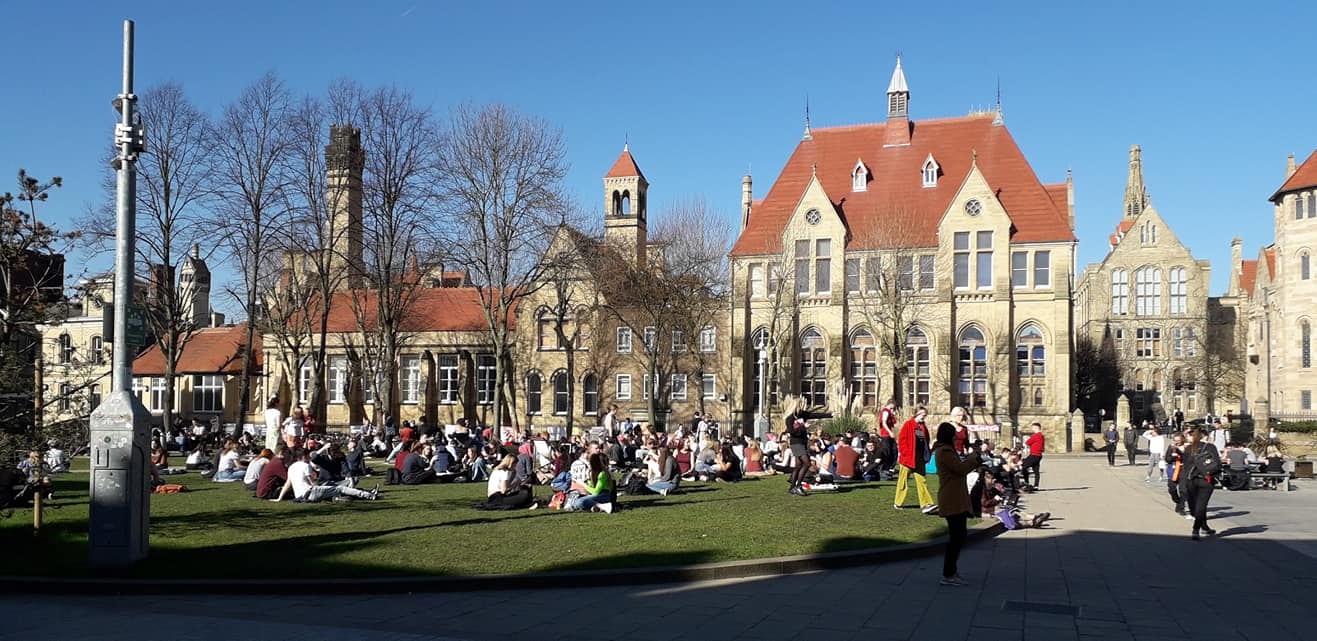 University of Manchester campus
Visa Process
Offer letter to
departure.
Five stages, handled by our documentation desk. You are told exactly what is needed at each one, and what it will cost.
University and course shortlist
We match your grades and budget across three tiers of university so you hold a realistic offer as well as an ambitious one.
Applications and offer letters
Filed directly, or through UCAS for undergraduate entry. Conditional offers usually arrive within two to six weeks.
Deposit and CAS
Pay the tuition deposit; the university issues your CAS number, valid for six months.
Financial evidence
Funds must sit in an eligible account for twenty-eight consecutive days before the application date — timing matters as much as the amount.
Student Route application
Filed online with IHS payment, biometrics and TB screening from an approved clinic in Kathmandu. Decisions typically in three weeks.
“The visa is not a lottery. It is a file — and a well-built file gets approved.”
Work rights &
after graduation
Scholarships
Money you might not be asking for.
Most students who qualify for funding never apply for it. We check every award your profile fits before submitting an application.
University international awards
£2,000–7,000 tuition reductions offered widely to South Asian applicants; often automatic on grades.
Chevening Scholarships
Fully funded master’s study for candidates with work experience and a leadership record; applications open each August.
Commonwealth Scholarships
Funded postgraduate study for candidates from Commonwealth countries, administered through nominating bodies.
Questions We Get
Honest answers.
Is a one-year UK master’s respected by employers?
What are the twenty-eight-day funds rules?
Can I bring dependants?
Do UK universities accept a three-year bachelor from Nepal?
Compare
Other destinations.
Almost no student arrives certain. Read two or three of these side by side before you decide.
Is the United Kingdom right
for you?
Bring your transcripts and your budget. In one free session we will tell you honestly whether United Kingdom fits — and what the alternative would be if it does not.
Walk-in welcome · New Baneshwor, Kathmandu